A history rooted in the Almohad dynasty
The Menara Gardens Marrakech history stretches back to the twelfth century, when the Almohad dynasty created this agricultural estate to supply the royal palace with water, food, and shade. The name Menara comes from the Arabic word for lighthouse or tower, a reference to the iconic pavilion that stands at the water’s edge. What you see today is the result of centuries of care, restoration, and royal patronage.
The garden was not designed as a decorative space. It was functional from the start, with the large basin serving as a hydraulic reservoir fed by an elaborate underground network of channels called khettaras, drawing snowmelt from the Atlas Mountains into the heart of the city. This engineering feat kept the olive grove irrigated and the city supplied through dry summers.
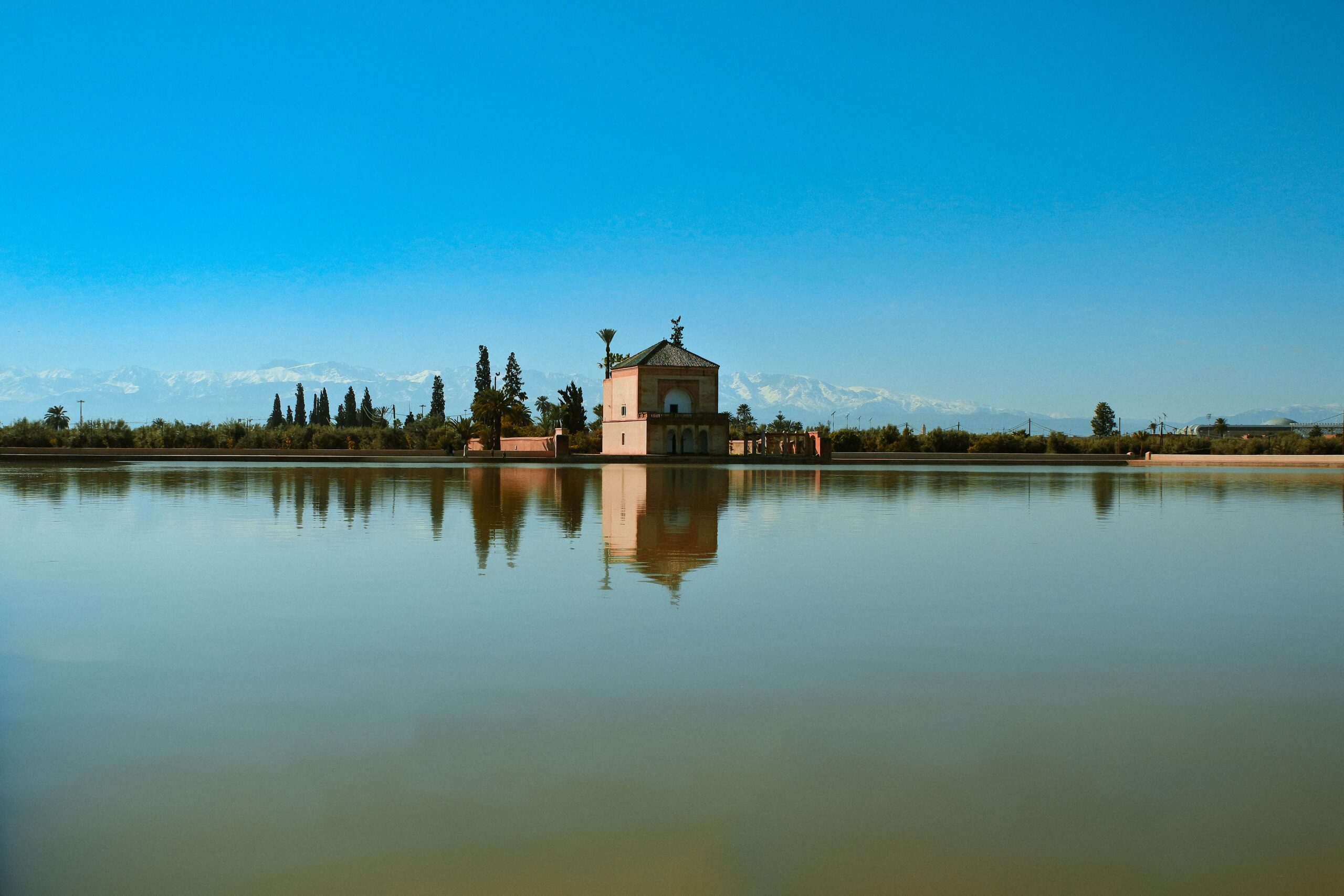
The green-roofed pavilion you see reflected in the water was rebuilt in the nineteenth century under Sultan Abd ar-Rahman. It served as a royal retreat, a place where the sultan could rest, receive guests, and look out across the olive grove toward the mountains. The two-storey structure is modest from a distance, but its position and proportions are deliberate, framing the landscape perfectly.
What to expect when you visit the Menara Gardens
Walking through the main entrance, you are immediately surrounded by one of the largest olive groves in Morocco. The trees are old, their trunks twisted and grey, their canopies casting irregular pools of shadow across the dusty ground. The Menara olive grove Marrakech is not simply decorative. The olives are harvested each autumn, and the grove continues to produce as it has for centuries.
The path leads toward the rectangular basin, which is the heart of the site. The water is calm and dark, and on clear days, particularly in winter and early spring, the reflection of the Atlas Mountains on its surface is one of those views that genuinely stops you mid-step. Many visitors arrive specifically for this view, which appears on countless photographs of Marrakech without people ever knowing exactly where it was taken.
The Menara pavilion Marrakech stands at the far edge of the basin. You can walk around the water’s edge and approach it directly. The ground floor is sometimes open to visitors, revealing a simple interior that once served the sultan’s private use. Whether or not the interior is accessible on the day you visit, the exterior and the view from the pavilion steps are worth the short walk on their own.
The Atlas Mountains view from the basin
The Atlas Mountains view Marrakech offers from the Menara basin is one of the clearest and most accessible in the city. You do not need to travel into the foothills or book a tour to see the mountains here. On a crisp morning between November and March, when snow still covers the higher peaks, the sight across the water is exceptional. Arriving in the early morning gives you the calm surface and softer light. By midday, visitors arrive in greater numbers and the reflections can be broken by the activity around the edge.
How long should you plan to spend there?
Most visitors spend between one and two hours at the Menara Gardens. That is enough time to walk the full perimeter of the basin, explore the deeper sections of the olive grove, and sit for a while near the pavilion. If you are building a Marrakech day trip itinerary, the Menara Gardens work well as a morning start before heading into the medina, or as a calming close to an afternoon spent among the souks.

When is the right time to visit?
The Menara Gardens can be visited year-round, but each season brings a different character. Winter and spring are the most rewarding seasons for the mountain views. The air is cooler, the light is cleaner, and the snowfall on the Atlas peaks makes the reflection across the basin especially striking. The olive trees show little seasonal drama, staying green and silver throughout the year, but the surrounding grass areas become more lush after winter rains.
Summer visits are possible but come with heat. The gardens offer shade, which makes them more comfortable than open sites, but the mountains are less visible through the summer haze. Autumn brings the olive harvest, which adds a different kind of life to the grove as workers move between the trees.
Morning visits are consistently recommended regardless of season. The light is better for photography, the crowds are thinner, and the surface of the basin is at its calmest before the afternoon wind picks up.
Things to do near Menara Gardens
The Menara Gardens sit on the western edge of Marrakech, close to the Hivernage neighbourhood and within easy reach of several other Marrakech landmarks and attractions. From here, you can reach the medina in under fifteen minutes by taxi or hired car. The Majorelle Garden, another of the city’s celebrated green spaces, is a short drive away and offers a contrasting experience: smaller, more ornate, and famous for its electric blue architecture and botanical collection.
The Agdal Gardens are the Menara’s historical counterpart. Also of royal origin and featuring a similar system of basins and orchards, the Agdal stretches south of the medina walls and is worth visiting if you want to understand the full tradition of royal garden design in Marrakech. Together, the two sites form a clear picture of how the city was sustained and beautified across centuries.
If you are curious about getting further into the landscape that frames the view from the Menara basin, a guided excursion into the Atlas Mountains foothills takes less than an hour from the city and opens up walking, village visits, and a completely different scale of scenery. Many visitors combine a morning at the Menara Gardens with an afternoon in the mountains, making it a naturally flowing day.
How to reach the Menara Gardens from central Marrakech
The gardens are located roughly three kilometres southwest of Jemaa el-Fna square. The simplest way to arrive is by taxi or a private driver. The ride from the medina takes around ten minutes depending on traffic. There is a car park near the entrance for those arriving independently. Arriving on foot is possible from the Gueliz neighbourhood, though the walk takes closer to thirty minutes along Avenue de la Menara.
If you are travelling with a private guide or as part of an organised tour, the Menara Gardens are easily included as a stop within a broader city itinerary. The site requires no advance booking for standard entry, and the relaxed pace of the gardens makes it one of the more flexible additions to a Marrakech day.
A quiet place that stays with you
The Menara Gardens do not ask much of you. There is no dense programme of sights to tick off, no audio guide to follow, no prescribed route. You walk, you look, you sit beside the water. The experience is cumulative. The longer you stay, the more the detail of the place accumulates: the texture of the old olive bark, the specific quality of the light on the water, the presence of the mountains on the horizon.
In a city as layered and stimulating as Marrakech, a space like this earns its place precisely because it gives you room to breathe. Menara Gardens Marrakech is one of those places you carry home not as a photograph but as a feeling. If you would like to build a private itinerary that includes the gardens alongside other carefully chosen stops across the city and beyond, our team at Marrakech private tours would be glad to help you put it together.