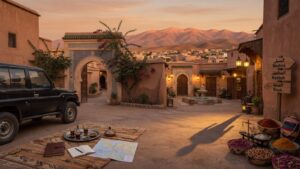
In southern Morocco, jewellery is never merely decoration. For the Berber (Imazighen) people, every necklace, bracelet, and fibula carries a language — speaking of tribal identity, marital status, social standing, and ancient spiritual beliefs passed through generations.
The Wedding Necklace: Wealth, Tribe & the God of Joy
In southern Morocco, the days leading up to a wedding are steeped in ritual. A young bride is helped into her clothes and jewellery while women gather around her, singing and performing rites dedicated to Warru — the god of joy and happiness — asking for blessings upon the new couple.
At the centre of this ceremony is an intricate necklace: a layered composition of amber, coral, and smooth agate-coloured stones such as carnelian. For many brides, it will be the first time she has worn such a piece. It is not simply beautiful — it represents wealth, prestige, and acts as a visual declaration of the tribe to which she belongs.
The wedding is called Tamghra, which means “the invitation.” Amber resin beads — Loban — are traditionally used as wedding dowry.
Key Pieces of Amazigh Jewellery
The Horned Bracelet — Abzg n iqurraïn
Also known as le Bracelet à Douze Pointes, this silver bracelet features a dramatic 12-point star at its centre. Weighing approximately 1.5 kg each, women may wear one on each wrist. Beyond adornment, it symbolises strength and vitality — and can serve as a defensive weapon. 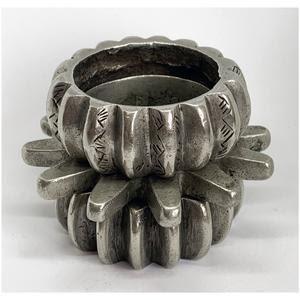
The Fibula — Amazigh Robe Clasp
Crafted from Moroccan silver mixed with enamelled metal and brass, fibulae are worn on the chest to fasten robes. Their position carries meaning: worn on the right, it signals an unmarried woman; worn on the left means her heart is taken. The size of a woman’s fibula also indicates her social rank. 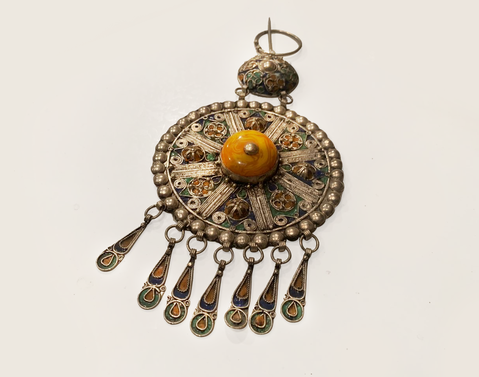
Wedding Necklace — Amber & Carnelian
Layered with amber, coral, and carnelian stones, the bridal necklace marks one of life’s most significant transitions. It is among the first pieces a bride ever wears and carries the prestige of her tribe and family lineage. 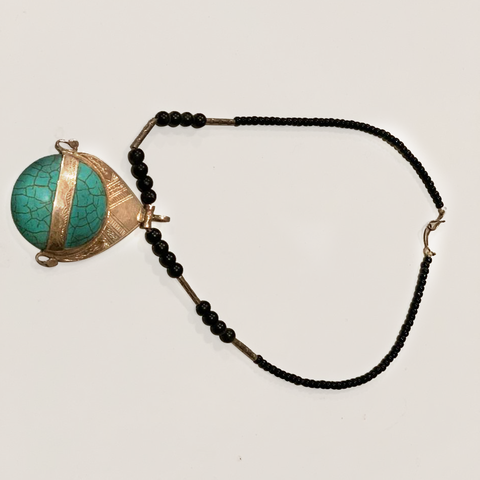
Amber Resin Beads — Loban
Amber resin beads are traditionally offered as part of a wedding dowry. Their warm golden tones connect the wearer to prosperity and the natural world — precious for their rarity and the rich meaning they hold in Amazigh ritual. 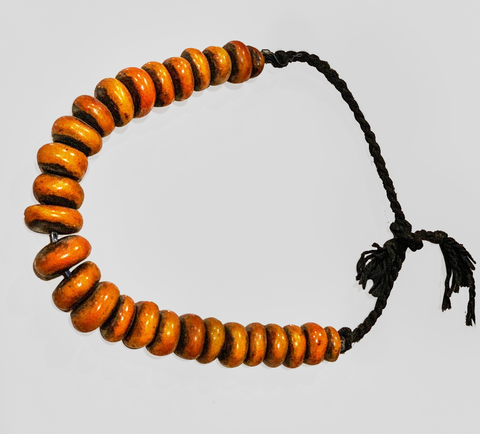
Berber Hair Clip
Ornate hair clips in silver and mixed metal complete the traditional Amazigh look. As with all pieces in this tradition, the hair clip speaks of personality, personal wealth, and cultural identity — jewellery as autobiography. 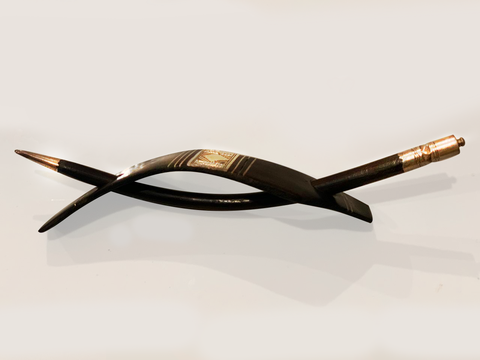
Stacked Silver Bracelets
Berber women wear thick silver bracelets, layered in sets on each wrist. They symbolise strength and vitality, and can be worn as instruments of self-defence. In rural areas, silver is the dominant metal; in cities, gold is preferred. 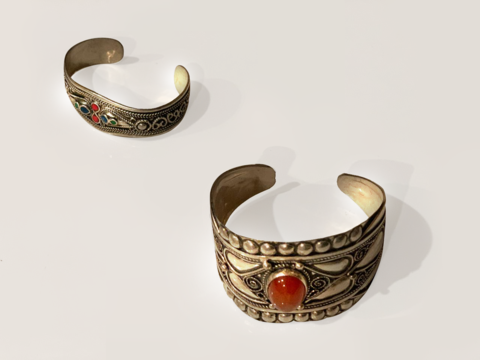
The True Value of Amazigh Jewellery
Antique Moroccan Amazigh jewellery contributes to recording popular memory. These pieces are deep, sensual, and emotionally resonant — touching the eye, the mind, and all the senses. Each item is a work of art whose value increases with time, rich in the interplay of colours that converge and diverge, charming and lustrous.
But the truest value of traditional jewellery lies beyond its material worth. It is one of the tributaries of the authenticity and historical depth of the Berbers (Imazighen) in Moroccan heritage. These pieces carry the myths of the past and the traditions of an ancient civilisation — more symbolic than literal, leaving traces that are anything but forgettable.
In Amazigh culture, jewellery provides a certain transparency: it speaks of the personality and wealth of the wearer. It combines stylistic richness and creative specificity — in subject and technique alike — as innate impulses that return us to the spontaneity of beauty in the everyday.
Amazigh jewellery exudes the fragrance of the past and the pulse of the present. You cannot help but stand dazzled by the splendour of designs, the warmth of colours, and the harmony of details.
Characteristics of Traditional Berber Jewellery
The traditional jewellery industry of southern Morocco — along the foothills of the High and Small Atlas Mountains — is driven by an obsession with rootedness and excellence. These regions balance awareness of heritage with ambition for modernity, drawing on an innate knowledge rich in craft technique to record popular memory.
Unlike the painter who signs a canvas at the bottom, the jewellery maker leaves no name. These are anonymous artists — their work a mobile painting carried on the body. Yet their mastery is unmistakable. Amazigh jewellery holds details and glimpses from East and West, fused by the artist’s hand into rare masterpieces that preserve a distinctly Amazigh style and expression.
The arts of engraving, stretching, smelting, and mould-casting all feature in the making of Amazigh jewellery. Metal is chosen for its flexibility and capacity for synthesis. The resulting aesthetic — a metallic elegance combining tenderness with simplicity — reflects a flavour of nobility that exudes the glory of history and the splendour of nature.
Berber Jewellery Symbols Explained
Amazigh motifs combine geometric shapes with the full weight of popular memory — tattoos, symbols, and stars drawn from ancient Berber cosmology. Each pattern is intentional:
- Circular shapes — represent sanctity; women are associated with sacred solar and lunar forms.
- Palm frond decorations — symbolise production, abundance, prosperity, and fertility. The palm tree is the tree of life in popular memory, signifying flowing water.
- Triangles, rhombuses, and deviated squares — geometric forms that carry tribal identity and act as visual clan markers.
- Stars (including the 12-point star) — found on the iconic Abzg n iqurraïn bracelet; associated with celestial power and protection.
- Braided strings of gold or silver — leave their original stamp on the metal, making history look beautiful regardless of age.
These symbols testify that the Amazighs fused and responded to many cultures and civilisations throughout history — enriching their heritage without surrendering its singular voice.
The Psychology of Colour in Berber Jewellery
Amazigh jewellery is inspired by mythology, and nowhere is this clearer than in its use of colour. Each hue is not decorative but diagnostic — it carries a reading of the world. As the Moroccan saying goes: the eye needs colour as much as it needs light.
Colours leave a special effect on the wearer and create a special rhythm that prolongs feelings and emotions — elevating, calming, exciting, relieving, soothing, and dazzling. They act as a mirror reflecting the inner life, because the psychological expression of coloured gemstones emerges from deep within and helps balance emotion.
| Colour | Symbolism | Associated Qualities |
|---|---|---|
| Green | Youth, emotion, and a good life | Vitality, hope, natural abundance |
| Blue | Calm and peace | Serenity, protection, clarity |
| Red | Warmth, love, courage, and strength | Passion, power, protection from evil |
| Amber / Orange | Prosperity and prestige | Wedding dowry, wealth, solar energy |
A Tradition That Refuses to Be Lost
Today, a new phenomenon has emerged around Amazigh jewellery: foreign travellers roam the countryside and villages in search of these near-lost artefacts. Tourists flock to rural areas, drawn to the mysterious magic that surrounds each piece. Acquiring these antiques has become like searching for lost treasure. 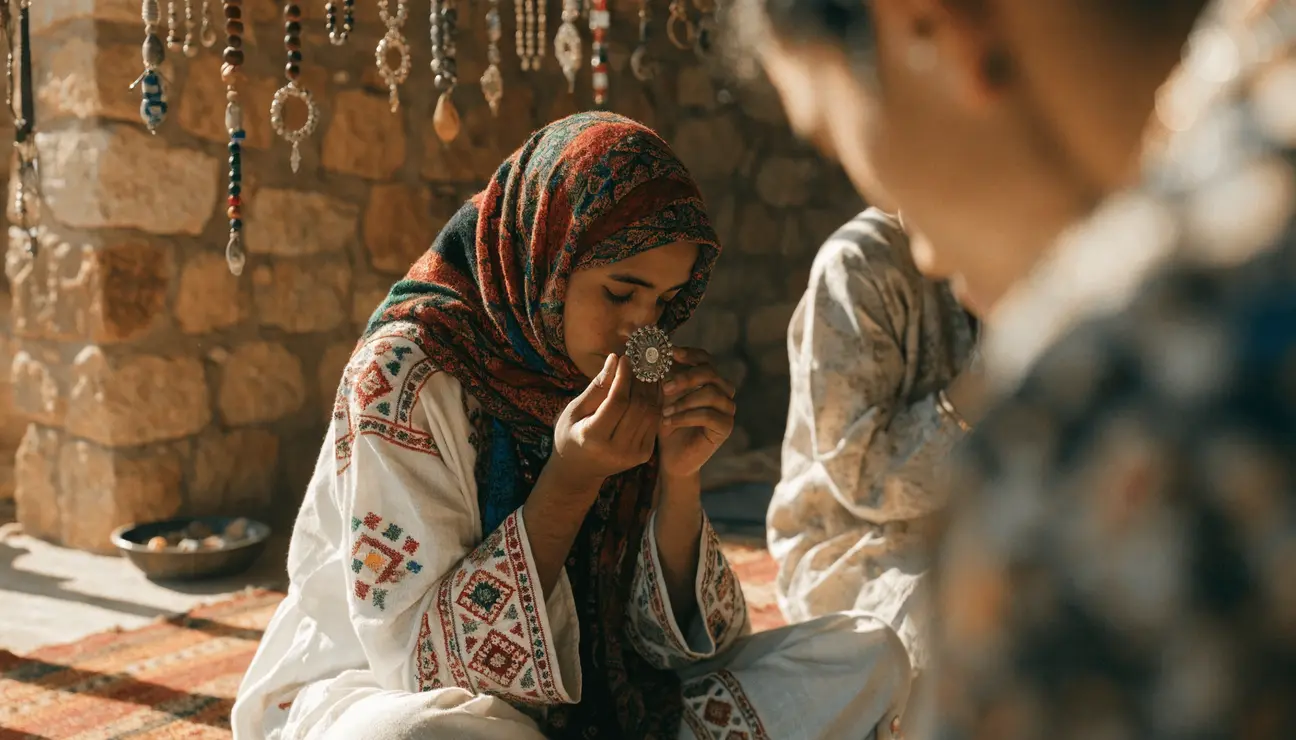
These are not simply pretty objects. They are witnesses to family joys and tribal rituals, souvenirs laden with feeling, and repositories of emotional and moral value that far exceeds any market price. The jewellery shines more beautifully in others’ eyes precisely because of the weight of meaning it carries.
Amazigh jewellery holds details and glimpses from the East and West, mixed by the artist’s hand into rare masterpieces — preserving a style and expression unique to the Imazighen, one that searches for the charm of colours and the accuracy of shapes to highlight aesthetic values found nowhere else on earth.
They are transparent like diamonds, authentic like gold, and honest as precious stones.