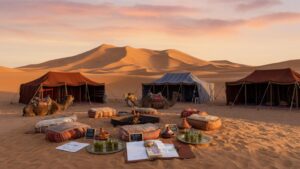
Most people picture Morocco as sand dunes, terracotta walls, and relentless heat. Then they visit Ifrane, and everything they assumed gets quietly dismantled. Morocco alpine villages like Ifrane sit at over 1,600 metres above sea level, surrounded by oak and cedar forest, with streets clean enough to eat from and air cold enough in winter to sting your face. This is Middle Atlas travel at its most unexpected, and it rewards anyone willing to look beyond the obvious.
What makes ifrane so different from the rest of Morocco?
Ifrane is a planned mountain town built by the French Protectorate in the 1930s, designed to resemble a European alpine resort. It sits in the Middle Atlas at roughly 1,650 metres elevation, giving it a climate and landscape unlike anywhere else in the country.
The first thing you notice is the architecture. Steep-pitched slate roofs, timber-framed facades, and quiet avenues lined with pine trees. The comparison to a Swiss-style town in North Africa is not exaggeration, it is the accurate first impression of almost every visitor. The streets are swept. The parks are maintained. There are roundabouts with flower beds.
What Ifrane represents, more than anything, is the sheer range of Morocco beyond the desert. In one country you can wake up to camels at sunrise in the Sahara and, three days later, walk through snow-dusted cedar forest watching monkeys. That contrast is not a travel cliché. It is simply geography.
How to plan a day trip from Fes to ifrane
A day trip from Fes to Ifrane is entirely feasible and takes roughly one hour by car on the N8 road south through the mountains. Most visitors combine Ifrane with Azrou and the cedar forest into a single full-day loop.
Here is a practical sequence for the day:
- Leave Fes by 8am to arrive in Ifrane before the midday coach groups.
- Walk the town centre, the famous stone lion sculpture, and the lakeside gardens for about 90 minutes.
- Drive 17 kilometres south to Azrou for the cedar forest and Barbary macaques.
- Stop for lunch in Azrou town at one of the small restaurants on the main square.
- Return via the Ain Leuh waterfall or the panoramic plateau road depending on season and conditions.
The cedar forest near Azrou is one of the largest in North Africa, and the drive through it alone justifies the detour. Towering Atlas cedars block out the sky in places, and the air smells of resin and earth in a way that is completely unlike the lowland Morocco most people experience.
Barbary macaques and the cedar forest of azrou
The cedar forest Azrou is home to a wild population of Barbary macaques, the only macaque species found outside Asia. Visitors encounter them directly on the roadside and inside the forest, where the monkeys approach with complete confidence.
Barbary macaques in Morocco are genuinely wild animals, not a managed attraction. They live in social troops throughout the Middle Atlas forests and are protected under Moroccan law. Feeding them is discouraged by conservation groups, as it disrupts their natural foraging behaviour and creates dependency.
Watching a troop move through the cedars is extraordinary in a quiet way. There is no enclosure, no soundtrack, no handler nearby. Just trees, cold air, and primates going about their morning. It is one of the most specific and memorable things you can do in the Middle Atlas, and it costs nothing beyond the drive to get there.
What to see in the middle Atlas beyond ifrane town
The Middle Atlas offers considerably more than Ifrane itself. The region’s lakes, plateaus, and mountain trails make it a serious destination for walkers, naturalists, and anyone interested in Morocco beyond the imperial cities.
Key places worth including in any Middle Atlas travel itinerary:
- Lac Dayet Aoua: a forest lake 10 kilometres from Ifrane with birdlife and walking trails around its perimeter.
- Ain Leuh: a Berber village with a waterfall and traditional weekly market, 26 kilometres south of Ifrane.
- Michlifen crater: a dormant volcanic crater turned into a small ski area in winter, sitting above the treeline.
- Azrou market town: the commercial hub of the region, with a Tuesday Berber market selling rugs, pottery, and produce.
Ifrane national park hiking trails connect several of these points and can be walked independently or with a local guide hired in Ifrane town. The trails are not technically demanding but require decent footwear given the forest terrain and elevation changes.
Is visiting ifrane in winter worth it?
Visiting Ifrane in winter is absolutely worth it for travellers who want a completely different dimension of Morocco. Between December and February, Ifrane receives snowfall regularly, transforming the town and surrounding forest into a landscape that looks nothing like the country at lower altitudes.
Moroccan families from Fes, Meknes, and Casablanca drive up to see the snow, and the town takes on a lively, domestic atmosphere that is quite different from tourist Marrakech. Ifrane and Michlifen are where Moroccans themselves go for winter weekends, which tells you something about the place’s authenticity.
Winter practicalities to consider:
- Temperatures regularly drop below freezing at night, so pack accordingly even for a day trip.
- The road from Fes stays open in normal snow conditions but can close after heavy falls.
- Many smaller cafes and guesthouses in Ifrane reduce hours or close between January and February.
- The cedar forest is particularly atmospheric under snow, and macaque sightings remain reliable year-round.
Spring and early autumn are arguably the most comfortable seasons, but winter has its own character that serious Morocco travellers should not dismiss.
Why Morocco alpine villages deserve a place in every itinerary
Morocco alpine villages represent a part of the country that most packaged tours skip entirely. Ifrane, Azrou, and the broader Middle Atlas corridor sit between the two great tourist anchors of Fes and Marrakech, yet they attract a fraction of the visitors.
The Middle Atlas is not a secondary destination, it is a counterpoint to the rest of Morocco’s intensity. After two days in a medina, the cedar forests and cold mountain air recalibrate everything. The silence is different at altitude. The light is different. Even the food, particularly the slow-cooked mountain lamb and the thick barley soups, shifts register.
For travellers planning a wider Morocco itinerary, the region pairs naturally with Fes to the north and Merzouga to the south. You can move from one extreme of the country’s geography to another in a single driving day, and Ifrane sits at the pivot point of that transition.
If you are thinking about how to structure a trip that captures Morocco’s full range, from imperial cities and mountain forests to desert landscapes, the things to do in Morocco guide covers the country’s most rewarding experiences across every region. And if timing is part of your planning, understanding what Morocco in July actually means for your trip will help you decide whether the Middle Atlas summer coolness is exactly what your itinerary needs.