A private guided tour Marrakech travellers choose over group excursions does something a standard itinerary cannot: it slows everything down. Instead of being swept through landmarks at pace, you stop, look, ask questions, and leave with a genuine understanding of the city rather than a camera roll of facades. This article walks you through what a private cultural tour of Marrakech actually looks like, from the first step into the medina to the quiet moments that no guidebook maps out.
What does a private guided tour of Marrakech actually include?
A private guided tour Marrakech experience is built around your interests, your pace, and the parts of the city that a knowledgeable local guide can unlock. Unlike a group tour, there is no fixed script and no waiting for others to catch up.
The structure varies by provider and by what you want to explore, but a well-designed private tour typically covers a combination of historic neighbourhoods, working craft quarters, and quiet residential streets that most visitors never reach. The medina of Marrakech, a UNESCO World Heritage Site, contains over 93 historic monuments within its walls. A private guide helps you understand what you are looking at rather than simply walking past it.
What separates a good private tour from a generic one is the depth of access. Your guide can take you into a functioning tannery, introduce you to a weaver mid-work, or sit with you in a neighbourhood café where tourists rarely pause. That contextual layer is what transforms a walk into an education.
How to explore the medina beyond the main squares
The Marrakech medina walking experience begins the moment you leave Jemaa el-Fna and move into the artisan quarters. The real texture of the city lives in the derbs, the narrow residential lanes that branch off the main souks and lead into neighbourhoods that have barely changed in centuries.
A private guide will take you through the Mouassine district, one of the oldest quarters in the medina, where 16th-century fountains sit beside family-run spice stalls. Walking through Mouassine with a guide reveals the social and architectural history of Marrakech in a way that a map simply cannot replicate.
The Marrakech souk immersion element of any private tour is where most visitors find their perspective shifts. The souks are organised by trade: dyers in one lane, leatherworkers in the next, then brass merchants, then woodcarvers. A guide explains the logic of the layout, which dates back to the medieval organisation of the city, and introduces you to craftspeople who are genuinely at work, not performing for tourists.
For those wanting to extend their time beyond the city walls, an Marrakech medina walking experience that includes the Menara Gardens offers a quiet counterpoint to the intensity of the souks, with an 18th-century pavilion and a vast olive grove that dates to the 12th century.
Local artisan workshops and what you learn inside them
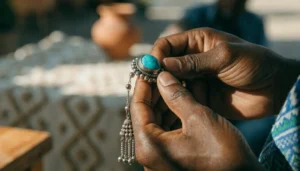
Local artisan workshops Marrakech visitors can access through a private tour are working studios, not showrooms. The distinction matters. In a showroom, you are a buyer. In a workshop, you are a witness to a craft that has been passed through generations.
Across the medina’s craft quarters, you will find:
- Zellige tile cutters who shape each piece by hand using a small hammer and chisel, a technique unchanged since the 14th century.
- Leather tanners working in open-air vats using natural pigments including poppy red, saffron yellow, and indigo blue.
- Carpet weavers in cooperatives where women produce Berber rugs using patterns that carry specific regional and symbolic meaning.
- Brass engravers who work without stencils, carving geometric patterns freehand into lanterns and trays.
Visiting these workshops with a guide means you understand the cultural context of what you are seeing, not just the visual spectacle. The guide can translate questions, explain the significance of particular patterns, and give you an honest sense of the time and skill involved in each piece.
What to do in Marrakech beyond sightseeing
What to do in Marrakech beyond sightseeing is a question that reveals how much the city has to offer once you move past the landmark checklist. Moroccan heritage exploration is most rewarding when it involves participation, not just observation.
Private cultural tours increasingly incorporate experiences that go beyond walking and looking. These include:
- A cooking session in a private riad kitchen, focused on the spice combinations and slow-cooking techniques behind Moroccan cuisine.
- A visit to a neighbourhood hammam, where your guide explains the ritual significance of the hammam in Moroccan social life before you decide whether to participate.
- A calligraphy or mosaic workshop led by a practising craftsperson who teaches the principles of Islamic geometric design.
- An early morning walk through the food souks, where the city is at its most local and least performative.
The authentic riad neighbourhood tour is another layer that many private guides offer. The riads of Marrakech are traditional courtyard houses that face inward, their ornate interiors hidden behind plain exterior walls. Walking through a riad neighbourhood with a guide who can point out architectural details, explain the philosophy of interior-focused design, and occasionally step inside a historic example turns an ordinary street into a living archive.
How to book a private driver in Marrakech and plan your day
How to book a private driver in Marrakech is straightforward when you work with a reputable tour operator. A private driver is not the same as a taxi: they are a dedicated resource for your day, available to move you between the medina, the palaces, the gardens, and any point outside the city walls without you negotiating routes or fares.
A customised itinerary Morocco visitors often request pairs a morning in the medina on foot with an afternoon drive to a site outside the city. The Ourika Valley, the Agafay Desert, and the Kasbah villages of the Draa Valley are all reachable in a half-day with a private driver.
When planning a Marrakech exclusive day trip that extends further, it helps to understand that southern Morocco requires more than a single day. If you are considering the Sahara, working with a specialist who can structure the journey properly makes a significant difference. The route from Marrakech to Merzouga covers some of the country’s most varied and dramatic landscapes, and doing it with a private driver and guide rather than a rented car changes the quality of the experience entirely.
For booking a private driver within the city, look for operators who provide licensed guides, fluent local knowledge, and a vehicle suited to the number of people in your group. Booking through your riad or a trusted tour operator is more reliable than arranging transport on the street.
Why a customised itinerary makes the difference
A customised itinerary Morocco travellers request from a private operator is the difference between a trip that fits your actual interests and one that follows a generic route every visitor takes. The value of private touring is not exclusivity for its own sake; it is relevance.
If you care about architecture, your guide focuses on the Saadian Tombs, the Ben Youssef Madrasa, and the lesser-known fondouks scattered through the medina. If food is your focus, the tour shifts toward markets, spice merchants, and producers. If you want to understand the social fabric of Moroccan life, the guide takes you into spaces that reflect that: a neighbourhood bakery, a Quranic school at the end of morning session, a weekly souk on the city’s edge.
Marrakech rewards the curious and punishes the rushed. A private cultural tour is the structure that allows genuine curiosity to be followed wherever it leads, without the constraint of a fixed group or a timed schedule. If you are ready to move beyond the surface of this city and into its living layers, start by exploring what Marrakech’s quieter corners have to offer, and build your day from there with a guide who knows the city as a home, not a highlight reel.