There is a moment, somewhere between the last light fading over Erg Chebbi and the first star appearing overhead, when everything goes completely quiet. If you have ever wondered what Sahara desert camping in Morocco actually feels like from the inside, not the photographs, not the travel brochures, but the raw, physical, sensory experience of it, this article will take you there.
What the journey to Merzouga sets you up for
The overnight dune experience at Merzouga begins long before you arrive at camp. The road from Marrakech winds through the High Atlas, drops into the Draa Valley, and slowly, over hours, the landscape hardens and empties until there is nothing but red earth and silence. The journey itself is part of the desert. By the time you reach the edge of the dunes, you have already been changed a little by the drive.
The Draa Valley stargazing excursion that some travellers add to this route is worth every early evening stop. The sky above the valley darkens faster than you expect, and the stars arrive in numbers that feel almost confrontational if you are used to a city sky. This is not a warm-up act. It is its own spectacle.
When you finally reach the base of the dunes at Erg Chebbi, the sand is finer than you imagined and the colour shifts from orange to deep red depending on the angle of the remaining light. The scale of the dunes is genuinely disorienting, and that disorientation, that feeling of your usual references falling away, is where the desert experience actually begins.
What a camel trek at sunset Erg Chebbi actually involves
A camel trek at sunset over Erg Chebbi takes roughly 45 to 90 minutes depending on your camp’s location within the dunes. The camels move at their own pace, and you will learn quickly that negotiating with them is not an option. Riders sit high enough to watch the shadow of the dune line creep across the sand below them as the sun drops.
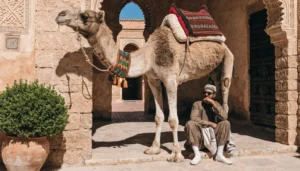
The silence on camelback is one of the things people consistently underestimate. There is no engine noise, no road sound, nothing except the soft compression of sand underfoot. Your guide, almost always a Berber man who has ridden these routes since childhood, will point out landmarks and read the dunes with a familiarity that makes you feel like a very welcome visitor in someone else’s home.
At the ridge of the dune, if your timing is right, you will watch the sun disappear behind the horizon while the sky turns through four or five distinct colours in under ten minutes. It is disarmingly fast. Photographers often miss the moment trying to find the right setting.
What does sleeping in a Berber tent in Morocco actually feel like?
Sleeping in a Berber tent in Morocco ranges from a traditional woven tent with floor cushions and lanterns to a fully furnished Morocco luxury glamping suite with a proper bed, electricity, and an en-suite bathroom. The style of your accommodation shapes the night entirely, but the experience of being inside the dunes after dark is the same regardless.
After dinner, which is typically a tagine cooked over fire and served communally under the open sky, the temperature drops noticeably. The desert at night is not the desert you walked through at dusk. The warmth stored in the sand during the day releases quickly, and by midnight the air has a serious edge to it.
Drums appear. Someone plays. The fire stays lit and the conversation around it is unhurried in a way that feels rare. This is the part that travel itineraries never quite capture: the quality of time in the desert is different. Hours pass without feeling wasted.
How cold does the Sahara get at night, and what should you pack?
The Sahara at night can drop to near freezing in winter months, typically November through February, and reaches cool-to-cold temperatures even in spring and autumn. In summer, nights remain warm, but the daytime heat means most serious trekking still happens at dawn or dusk. Temperature swings of 20 degrees Celsius between midday and midnight are common.
Knowing what to pack for desert sleeping makes the difference between a comfortable night and a miserable one. Here is what matters most:
- Bring a lightweight down jacket or a fleece you can layer over a base layer, even in shoulder seasons.
- Pack a wool or cotton scarf that doubles as a headwrap against the wind and sand.
- Wear closed shoes or boots for the camel trek, not sandals, the sand is deceptively sharp at the edges.
- Bring a torch or head lamp for navigating between tents after the fire dies down.
- Leave heavy luggage in Merzouga town. A small overnight bag is all you need inside the dunes.
For a deeper breakdown of what to prepare before you arrive, camping in the Sahara: what to expect covers the practical side in full detail, from camp facilities to what a typical night schedule looks like.
What waking up in the Sahara does to you
The alarm, if you set one, goes off around 5:30am. No one who has done this regrets it. The pre-dawn desert camp under the stars is the quietest, coldest, and most extraordinary part of the entire experience. The Milky Way, which was already visible the night before, has rotated overhead and the horizon is beginning to shift from black to navy to a thin, burning orange line.
Climbing the dune for sunrise takes effort. Your legs sink with each step and the sand is cold enough to feel through your shoes. But the view from the ridge as the light spreads across the dune field below you is the kind of image that does not require a filter and does not fade in memory the way most travel moments do.
By the time you are back at camp for mint tea and bread, the heat is already returning and the night feels like a different country entirely. That is the thing about the desert: it gives you several completely distinct worlds inside 24 hours.
How to plan a private Sahara tour from Marrakech
A private Sahara tour from Marrakech typically takes three days minimum to do properly: one full day of driving with stops, a night in the dunes, and a return journey that can vary by route. Rushing this trip produces a very different, much flatter experience. The Draa Valley, the Todra Gorge, and the kasbahs along the route deserve proper time.
The choice between a shared group tour and a private itinerary changes everything about how the experience feels. Private means your guide adjusts the pace to yours, your camp is selected ahead of time, and there is no negotiating with a group of strangers about when to leave the dunes.
If you are planning this from Marrakech and want to understand the route options, timing, and what to prioritise along the way, planning the Marrakech to Merzouga desert trip walks through every stage of the journey with the kind of detail that actually helps you decide.
A night in the Sahara is not a luxury add-on to a Morocco trip. It is one of those experiences that quietly reorganises your sense of what silence, darkness, and open space actually are. Book it properly, give it enough time, and you will understand exactly what we mean the moment that first star appears over the dunes.