Planning your first trip to Marrakech and wondering what to do in your first time in Marrakech without wasting a single hour? This guide covers everything: how to structure your time, where to sleep, when to go, and how to reach the Sahara if your schedule allows. Read this before you book anything.
What to do in Marrakech for 3 days: a practical day-by-day structure
Three days in Marrakech is enough to experience the old city deeply, take at least one day trip, and leave without feeling rushed. The key is sequencing your days so the medina comes first, excursions follow, and your final evening is free for Jemaa el-Fnaa square at night.
Day one belongs to the medina. Start at Jemaa el-Fnaa in the morning, when the square is calm and the light is soft. From there, walk north into the souks, then east toward the Medersa Ben Youssef and the Mouassine quarter. Afternoon is ideal for the Saadian Tombs and Bahia Palace. By evening, return to the square as it transforms into a stage of smoke, sound, and storytelling.
Day two is your day to exhale. Book a Marrakech day trip into the Atlas Mountains or toward the Ourika Valley. The drive from the city to the foothills takes roughly 45 minutes, and the contrast with the urban medina is immediate and striking.
Day three is for the details: a slower walk through the Mellah, the Jewish quarter, a visit to the Majorelle Garden, and a final afternoon in the souks. Leave the evening open.
How to plan a Morocco itinerary that goes beyond the city
Marrakech works perfectly as a base for a wider Moroccan itinerary. The city sits at the intersection of the High Atlas, the Atlantic coast, and the southern desert routes, which makes it the logical starting point for anyone who wants to see more of the country.
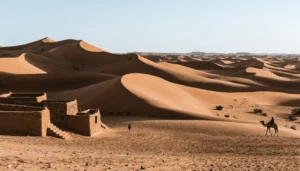
If you have seven days or more, the Marrakech to Sahara desert route is the journey that most travellers remember longest. The classic road runs through the Tizi n’Tichka mountain pass, drops into Ouarzazate, continues through the Draa Valley, and arrives at the dunes of Merzouga after roughly ten hours of driving. Most travellers break the journey with one or two nights along the route.
For a shorter extension, the road to Essaouira on the Atlantic coast takes about two and a half hours and offers a complete change of atmosphere: wind, sea, and a walled coastal medina with a very different character from Marrakech.
When thinking about how to plan a Morocco itinerary, the honest advice is to build in more time than you think you need. Morocco’s roads are scenic but not always fast, and the places worth stopping at are rarely signposted.
What is the best time to visit Morocco?
The best time to visit Morocco is spring, from late March through May, and autumn, from September through November. Temperatures during these months are warm but not extreme, and the light in the medina during these seasons is exceptional for photography and walking.
Summer in Marrakech means heat that regularly exceeds 38°C in July and August. The city does not slow down, but your energy will. Winter is mild by day, often cool at night, and perfectly pleasant for sightseeing. The Atlas Mountains can receive snow from December through February, which adds a dramatic backdrop to the city skyline.
Ramadan is worth understanding before you travel. Many restaurants open only after sunset during this period, and the rhythm of the city shifts noticeably. For some travellers, this is one of the most atmospheric times to visit. For others, the change to daily schedules is disruptive. Plan around it consciously rather than by accident.
Staying in riads in the old city: what you need to know before you book
Riads in the old city offer an experience that no hotel outside the medina walls can replicate. These are traditional courtyard houses, typically built around a central garden or fountain, and they sit inside the narrow pedestrian lanes of the medina where cars cannot reach.
The trade-off is arrival. Getting luggage to your riad requires planning. Most riads provide a meeting point near a car-accessible street, and a staff member walks you in. First-time visitors often underestimate how disorienting the medina lanes can be, so save your riad’s location in an offline map before you land.
When choosing a riad, look for properties inside the northern medina, close to the Mouassine fountain or the Bab Doukkala area, for easy access to both the souks and Jemaa el-Fnaa. Smaller riads with five to ten rooms tend to offer more personal service and quieter nights than converted guesthouses at the medina’s busier edges.
Souks shopping tips and how to navigate the medina on foot
The souks reward patience and penalise urgency. A Marrakech medina walking tour on your first morning will orient you faster than any map. Most guides take you through the spice souk near Rahba Kedima, the carpet souk off Souk el-Kebir, and the brass and lantern workshops further north.
For practical souks shopping tips Morocco first-timers rely on:
- Enter the souks with a rough sense of what you want rather than browsing aimlessly, or sellers will set the agenda for you.
- Prices are rarely fixed. A calm, friendly counter-offer at around fifty to sixty percent of the opening price is a reasonable starting point in most stalls.
- The best leather, ceramics, and textile workshops are often one street behind the main tourist lanes, where prices are lower and quality is frequently higher.
- Carry small bills. Paying with large notes for small purchases creates friction and sometimes ends a negotiation unnecessarily.
A private driver Marrakech arrangement is worth considering even within the city for anyone who finds the medina navigation exhausting. Many drivers offer half-day city orientation tours as well as longer private driver Marrakech excursions into the surrounding regions.
What makes the Atlas mountains day trip worth your time?
An Atlas Mountains day trip from Marrakech is one of the most rewarding single days you can build into a first visit. The High Atlas rises directly behind the city, and reaching the Berber villages of the Ourika or Asni valleys requires less than an hour by car.
The Ourika Valley runs along a river that turns fast and green after winter rains. In the village of Setti Fatma, a short hike leads to a series of waterfalls above the valley floor. The Asni road heads toward Jebel Toubkal, North Africa’s highest peak at 4,167 metres, and the trailhead town of Imlil is a two-hour drive from Marrakech.
Neither of these trips requires advanced hiking ability at the day-trip level. Both offer a direct encounter with Amazigh mountain culture that feels genuinely distinct from the city below. If you only have one day outside Marrakech, make it this one.
Marrakech rewards those who arrive prepared. Know your days, choose your base in the old city carefully, time your visit for spring or autumn if you can, and let at least one day take you beyond the city walls. For a personalised route through the country, from the medina lanes to the southern desert, Merry Morocco builds private itineraries around exactly how you want to travel.